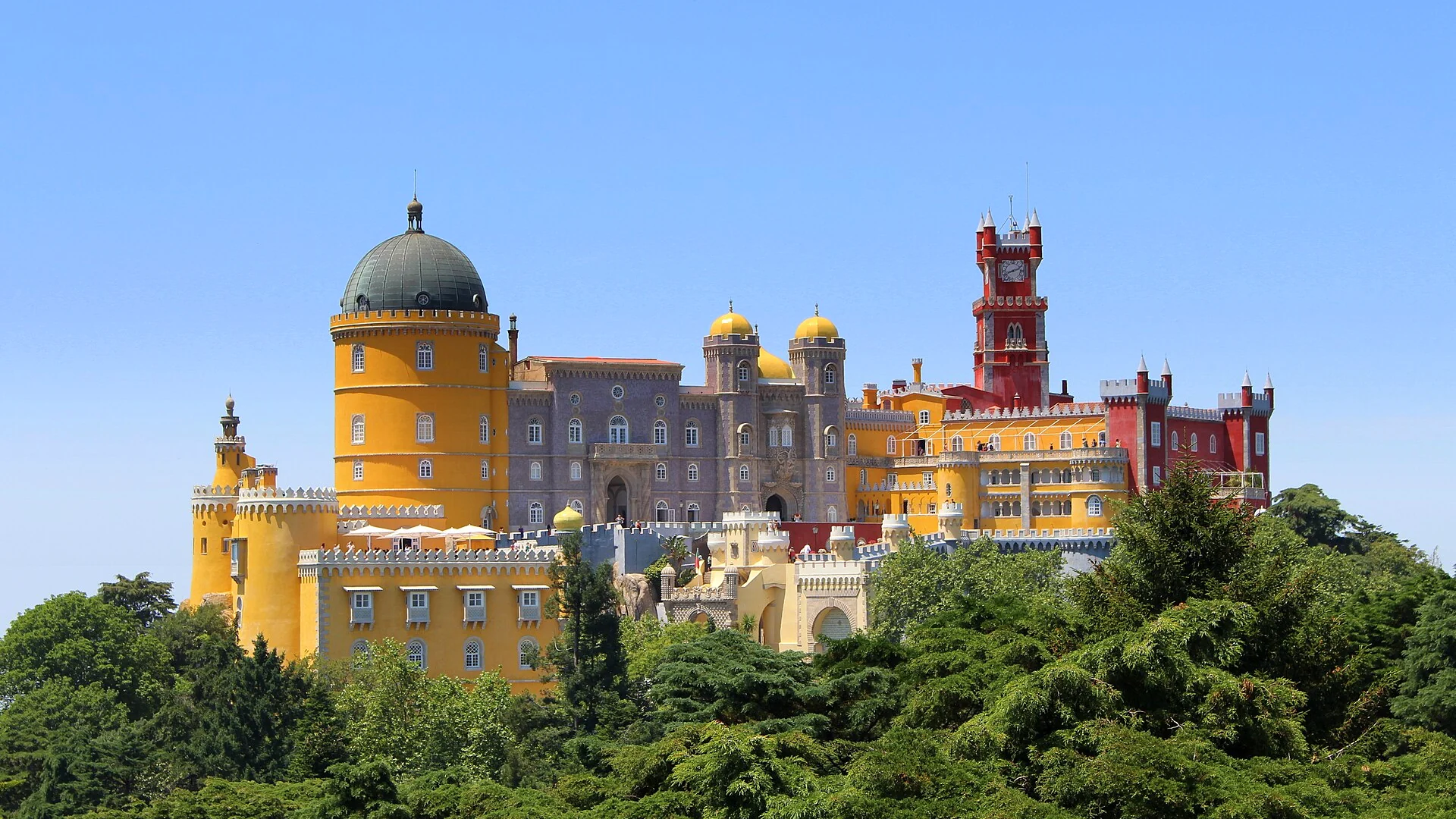

High on the granite spine of the Serra de Sintra, the Atlantic maritime fog collides with warm inland breezes, creating a perpetual swirl of damp mist. Out of this primeval cloud canopy rise the vivid canary yellows, washed ochres, and deep crimson battlements of the National Palace of Pena. It stands as Europe’s most theatrical royal playground, a fever dream of nineteenth-century Romanticism brought to life.
While Bavaria boasts its celebrated alpine fortress at Neuschwanstein Castle, Portugal offers a distinctly wilder coastal fantasy. Ferdinand of Saxe-Coburg and Gotha, King Consort to Queen Maria II, acquired the ruined sixteenth-century Hieronymite monastery perched atop the mountain in 1838. Rather than razing the shattered stone chapel left derelict after the Great Lisbon Earthquake of 1755, Ferdinand chose to envelop it inside an architectural composition that borrowed recklessly from every corner of the Portuguese empire.
This comprehensive Pena Palace Sintra guide unlocks the complex logistics, forested footpaths, and architectural secrets necessary to experience the pinnacle of Portugal romantic castles without becoming trapped in tourist logjams.
Architectural Eclecticism Above the Atlantic Clouds
Pena Palace is not a conventional royal fortification. It never repelled a siege or served as a strategic military bastion. Instead, it was designed by German amateur architect and mining engineer Wilhelm Ludwig von Eschwege as a summer sanctuary where high art met untamed nature. The palace presents an unruly riot of Neo-Manueline filigree, Moorish horseshoe arches, Gothic gargoyles, and Renaissance balustrades.
                                [ Cruz Alta Viewpoint (528m) ]
                                              ^
                                              | 25-minute forested climb
                                              |
[ Main Entrance Gate (360m) ] === (Valley of Lakes) ===> [ Pena Palace Terraces (480m) ]
                                                                |
                                                                v
                                              [ Chalet of Countess of Edla (410m) ]
The Vision of the King-Artist
Ferdinand II possessed a visionary artistic temperament. He instructed Eschwege to preserve the original Manueline cloister and the delicate alabaster altarpiece attributed to Nicolas Chantereine. Around that monastic footprint, the builders raised dramatic watchtowers, drawbridges that span dry chasms, and domes patterned after North African mosques.
The color coding of the exterior tells the historical story of the structure. The soft pink sections occupy the historic monastery and chapel complex. The vivid ochre and sunflower yellow facades designate the nineteenth-century additions commissioned by Ferdinand. When the midday sun cuts through the coastal fog, the sheer chromatic impact against the deep green mountain canopy is staggering.
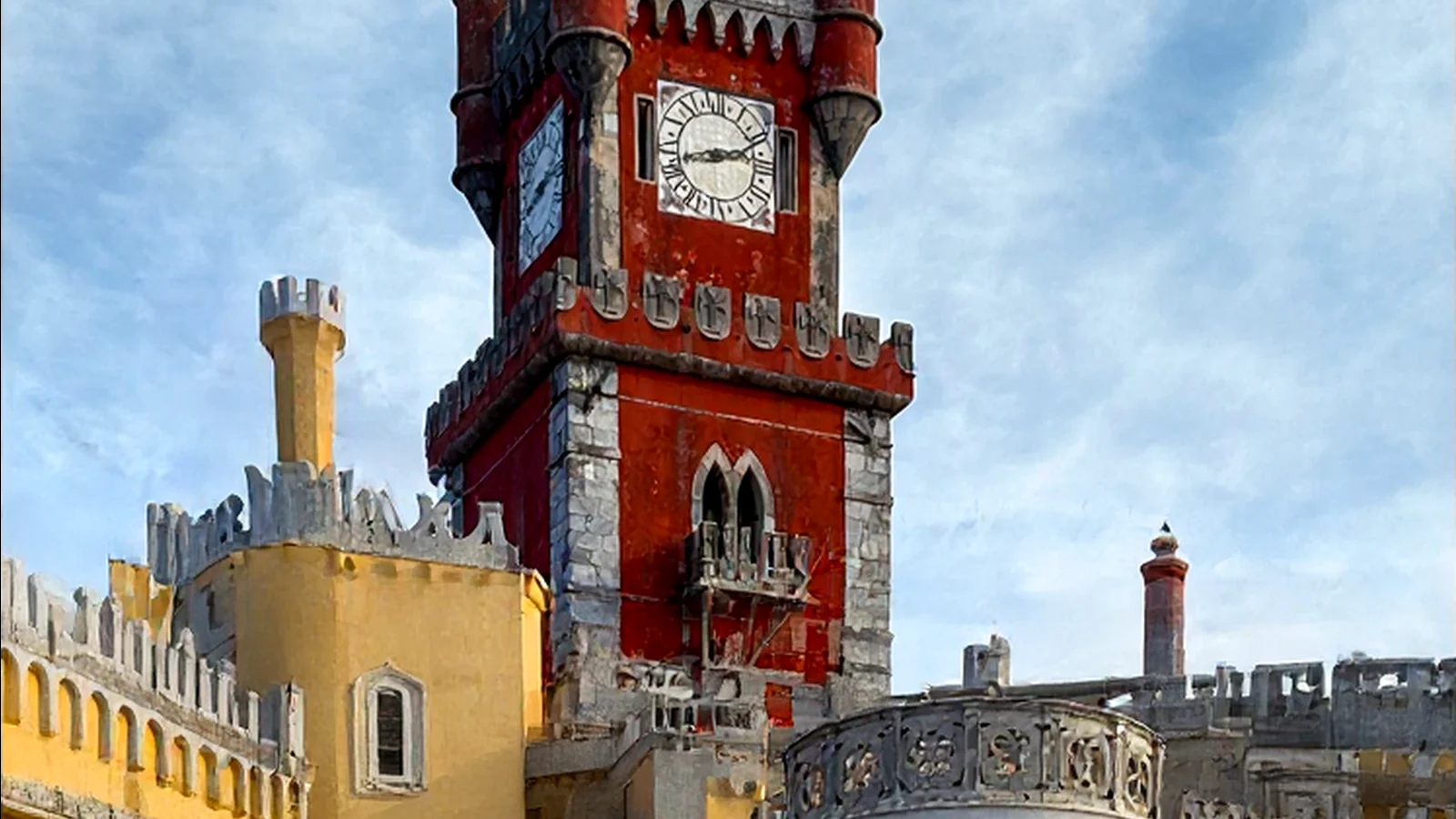 Caption: Neo-Manueline stone carvings and the fearsome Triton gateway dominate the courtyard access routes.
Key Architectural Hotspots
The architectural showpiece is unquestionably the Portico of the Triton. Here, a monstrous half-man, half-fish allegorical figure sits over an archway of stone corals and creeping vine tendrils, his shoulders supporting a bay window. The figure represents the creation of the world out of the ocean depths, a direct nod to the Portuguese Age of Discovery.
Beyond the Triton Gate, the Queen’s Terrace features a striking sundial cannon that once fired automatically every day at noon via an optical lens. Walking the wall walk offers dizzying drops into the forested gorges below, looking down toward the Atlantic coastline shimmering just twenty kilometers to the west.
Navigating the 200-Hectare Cloud Forest
The palace grounds cover far more than battlements and formal state rooms. Ferdinand spent decades acquiring the adjacent agricultural and scrub lands, importing over two thousand plant species from all four corners of the globe. North American sequoias, Japanese cryptomerias, Australian tree ferns, and Chinese ginkgo bilobas were planted alongside native Mediterranean cork oaks and stone pines.
The result is a cool, damp microclimate where moisture-condensing canopies drop steady rainwater even during dry summer months. Trails wind along stone-rimmed streams, past hidden pavilions, and through moss-laden boulder fields.
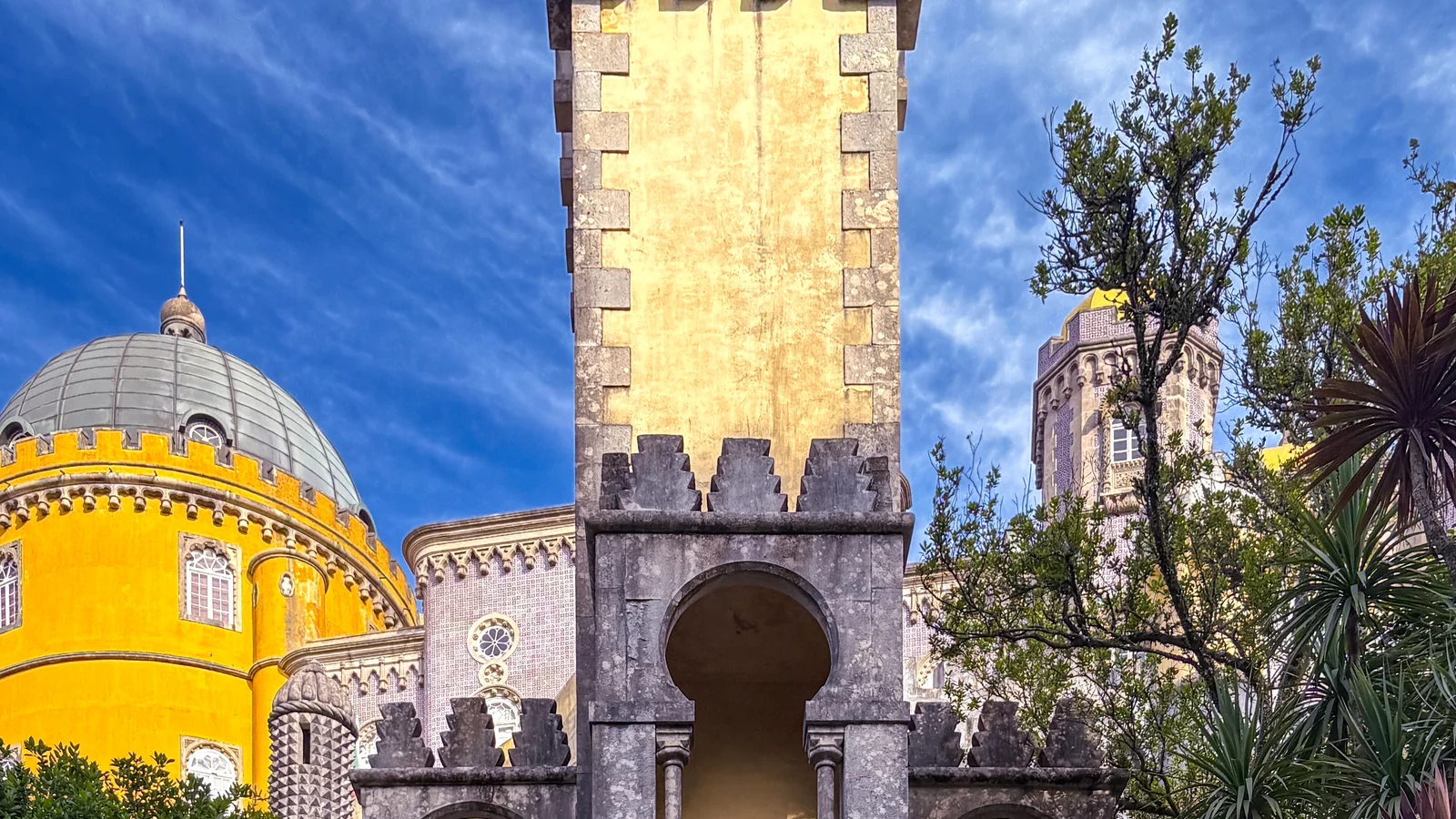 Caption: The colorful battlements of Pena Palace emerge dramatically above the misty canopy of the Sintra hills.
From Cruz Alta to the Chalet of the Countess of Edla
A broad path leads southwest from the palace toward Cruz Alta, the highest peak in the Sintra mountain chain at 528 meters above sea level. Marking the summit is a stone cross set into raw granite blocks. From this vantage point, you look down directly onto the palace profile, taking in the full silhouette of domes, turrets, and terraces framed against the Atlantic ocean.
Descending west from the high ridges, an isolated gravel trail leads to the Chalet and Garden of the Countess of Edla. Built between 1869 and 1879 by Ferdinand II and his second wife, Elise Hensler (the Countess of Edla), this romantic alpine chalet utilizes native cork oak bark for decorative thermal cladding, exterior balconies, and door frames. It remains one of the quietest corners of the estate, bypassed by the overwhelming majority of day-trippers.
Field Note from the Trail: Never take the highway shuttle bus up from the main Sintra train station if you arrive between 09:30 and 13:00. The serpentine mountain road turns into gridlock. Instead, book the 09:30 palace interior entry slot, catch the earliest 07:45 train from Lisbon Rossio, and walk up the shaded Caminho de Santa Maria footpath. You will reach the park entrance gates relaxed, unhurried, and completely ahead of the tour coach convoys.
Essential Route and Waypoint Metrics
The park encompasses dozens of kilometers of interconnecting gravel paths and paved service trails. To navigate the primary highlights efficiently during a Sintra day trip guide outing, consult this field elevation profile.
| Waypoint / Landmark | Elevation | Distance | Difficulty | Key Highlights |
|---|---|---|---|---|
| Sintra Historical Center | 205 m | 0.0 km | Easy | Cobbled streets, historic cafes, entry to trailheads |
| Caminho de Santa Maria Trailhead | 215 m | 0.4 km | Moderate | Shaded stone footpath, views of Moorish Castle outer walls |
| Moorish Castle Outer Gate | 420 m | 2.1 km | Strenuous | Tenth-century battlements, dramatic northern valley vistas |
| Pena Palace Main Entrance Gate | 360 m | 2.7 km | Moderate | Ticket control point, automated luggage lockers, gift kiosk |
| Pena Palace Courtyards | 480 m | 3.5 km | Moderate | Triton Gateway, Chapel of Saint Jerome, Queen’s Terrace |
| Cruz Alta Summit | 528 m | 4.8 km | Moderate | Highest point of the Serra de Sintra, full palace panorama |
| Chalet of Countess of Edla | 410 m | 6.2 km | Easy | Cork-clad alpine timber house, quiet botanical collection |
| Valley of the Lakes | 335 m | 7.5 km | Easy | Cascading duck ponds, miniature neo-Gothic stone castles |
Hikers seeking raw elevation gains and dramatic terrain will find these trails reminiscent of coastal mountain footpaths like the Amalfi Coast Trails, though Sintra features heavily manicured botanical canopies rather than bare limestone scrub.
Field Logistics: Transit, Tickets, and Beating the Crowds
The logistics of visiting Pena Palace require advance planning. The Sintra hills handle millions of visitors annually, and vehicle restrictions prevent personal cars from accessing the upper palace roads without dedicated local permits.
Trains, Bus 434, and Hiking Routes
The smoothest transit approach begins at Lisbon’s historic Rossio Station. Trains operated by CP (Comboios de Portugal) depart every 20 minutes on weekdays and every 30 minutes on weekends. The journey costs €2.40 each way using the reusable Navegante transit card and takes 40 minutes to reach Sintra terminal station.
From the Sintra station forecourt, you have three distinct ascent choices:
- Bus Route 434 (Circuito da Pena): Operated by Scotturb, this bus runs a continuous loop from the station to the Moorish Castle and Pena Palace. A 24-hour hop-on hop-off pass costs €8.40, while a one-way transfer costs €4.55. Queues at the train station bus stop routinely exceed 45 minutes after 10:00.
- The Caminho de Santa Maria Footpath: This 2.5-kilometer forested trail begins just past the Museu Ferreira de Castro in the historic center. The trail climbs steadily beneath old oak canopies, insulated from vehicle exhaust. Wear sturdy trail runners with rubber traction, as the stone pavers can turn slippery from morning condensation.
- Local Rideshare or Licensed Taxi: A pre-booked ride from Sintra station to the upper palace gate costs between €7.00 and €12.00, though early morning booking is essential to avoid surge pricing and vehicle access checkpoints.
Timed Entry Secrets and Culinary Stops
Tickets must be purchased online in advance through the official Parques de Sintra website to secure the standard 15% booking discount. A combined ticket for the Palace and Park costs €20.00 for adults, while a Park-Only ticket costs €10.00.
Crucially, the timed entry slot printed on your ticket (for example, 10:30) applies specifically to the interior palace entrance door, not the main park gates down by the road. It takes roughly 25 to 30 minutes to hike from the park entrance gate up to the palace doors. If you miss your allocated 30-minute palace entry window, park attendants will deny you access to the state rooms without a refund.
Before boarding the train back to Lisbon, stop in Sintra’s historic town center at Casa Piriquita. Founded in 1862, this historic bakery is famous for two regional pastries:
- Travesseiros de Sintra: Flaky puff-pastry pillows filled with rich almond cream and egg yolk paste, dusted with granulated sugar and served warm from the ovens (€1.80).
- Queijadas de Sintra: Crisp, thin pastry shells packed with a dense filling of fresh cottage cheese, sugar, flour, egg yolks, and fragrant cinnamon (€1.60).
Pair these pastries with a strong espresso to cap off an intense day of exploring Portugal’s grandest royal sanctuary.
Frequently Asked Questions
Is the Palace Interior ticket necessary, or is the Park-Only ticket sufficient?
For most hikers and architecture enthusiasts, the Park-Only ticket is the superior option. The interior state rooms are often crowded, and visitors must walk through in a tightly packed, single-file line. The Park-Only ticket grants full access to the exterior courtyards, the Triton Gate, the Queen’s Terrace, Cruz Alta, the Valley of Lakes, and the Countess of Edla Chalet, which are the true visual highlights of the estate.
Can I drive my rental car directly up to Pena Palace?
No. Sintra’s municipal government has permanently closed the upper mountain access roads (Estrada da Pena) to unauthorized private vehicle traffic. Non-resident cars are turned away at security barriers at the foot of the hill. Park your car at a suburban train station outside Sintra, or utilize the public parking lots down near Portela de Sintra before continuing by train or foot.
What should I wear when exploring the palace grounds?
Layered clothing is essential. The Serra de Sintra possesses its own unique oceanic microclimate. Temperatures at the palace terraces can be five to eight degrees Celsius cooler than in downtown Lisbon, frequently accompanied by high winds and thick fog. Bring a lightweight windbreaker or waterproof shell, and wear closed-toe walking shoes or trail runners with aggressive rubber outsoles for the damp granite paths.
What are the best hours to visit to avoid crowds?
The optimal hours to explore the palace are between 09:00 and 10:30, or after 16:00 in the late afternoon. Between 11:00 and 15:30, large bus tour excursions flood the main terraces and palace corridors. If you visit late in the day, the setting sun casts a striking warm glow against the ochre towers as the afternoon fog rolls out toward the sea.