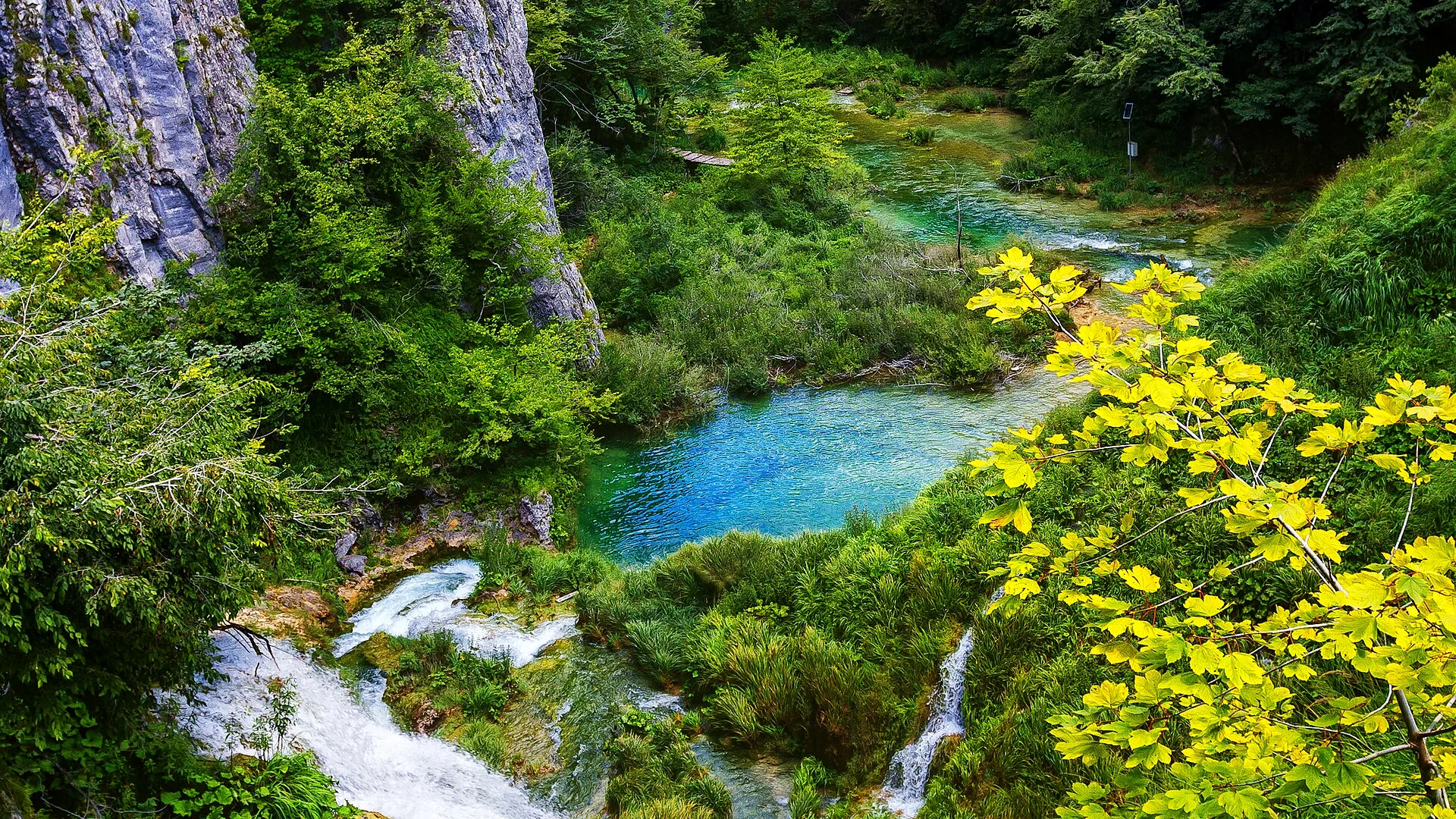

A pale morning mist clings to the surface of Lake Kozjak, rising in thin white curls against the limestone cliffs. Long before the midday tour buses pull into the asphalt lots, the only sound vibrating through the gorge is the steady roar of tumbling water. Plitvice Lakes National Park is famous across the globe for its terraced basins and turquoise shallows, but stepping onto its timber paths without a clear strategy often means sharing narrow walkways with thousands of day-trippers.
By stepping away from the standard sightseeing circuits and charting a course along the quieter trails, you enter a living karst landscape shaped over millennia. This Plitvice Croatia guide reveals how to bypass the bottlenecks, experience the quietest stretches of travertine, and witness the power of water cutting through wild beech forests.
The Karst Engine: Understanding the Living Waters
To hike Plitvice with real appreciation, one must grasp the delicate chemistry taking place beneath the soles of your boots. The park consists of sixteen named lakes and dozens of nameless intermediate pools, divided neatly into the Upper Lakes (Gornja Jezera) and Lower Lakes (Donja Jezera). What separates this canyon from standard mountain lakes is the phenomenon of dynamic tufa, also known as travertine.
Mosses, algae, and bacteria capture calcium carbonate from the mineral-heavy water, depositing rock layers at a rate of roughly one centimeter per year. Over centuries, these microscopic organisms have built towering dams, subterranean caverns, and delicate curtains of falling water. A fallen tree branch submerged in the water does not rot easily; instead, it becomes calcified, turning into a petrified spine that forms the foundation of future waterfalls.
Because of this constant geological growth, the landscape shifts year after year. Paths that were dry five seasons ago can find themselves awash in spring run-off, while waterfalls change their channels as limestone thresholds crack and rebuild. Much like the mineral formations celebrated in our Dolomites Travel Guide, the white stone here defines every visual contrast against the green water and dark evergreen forest.
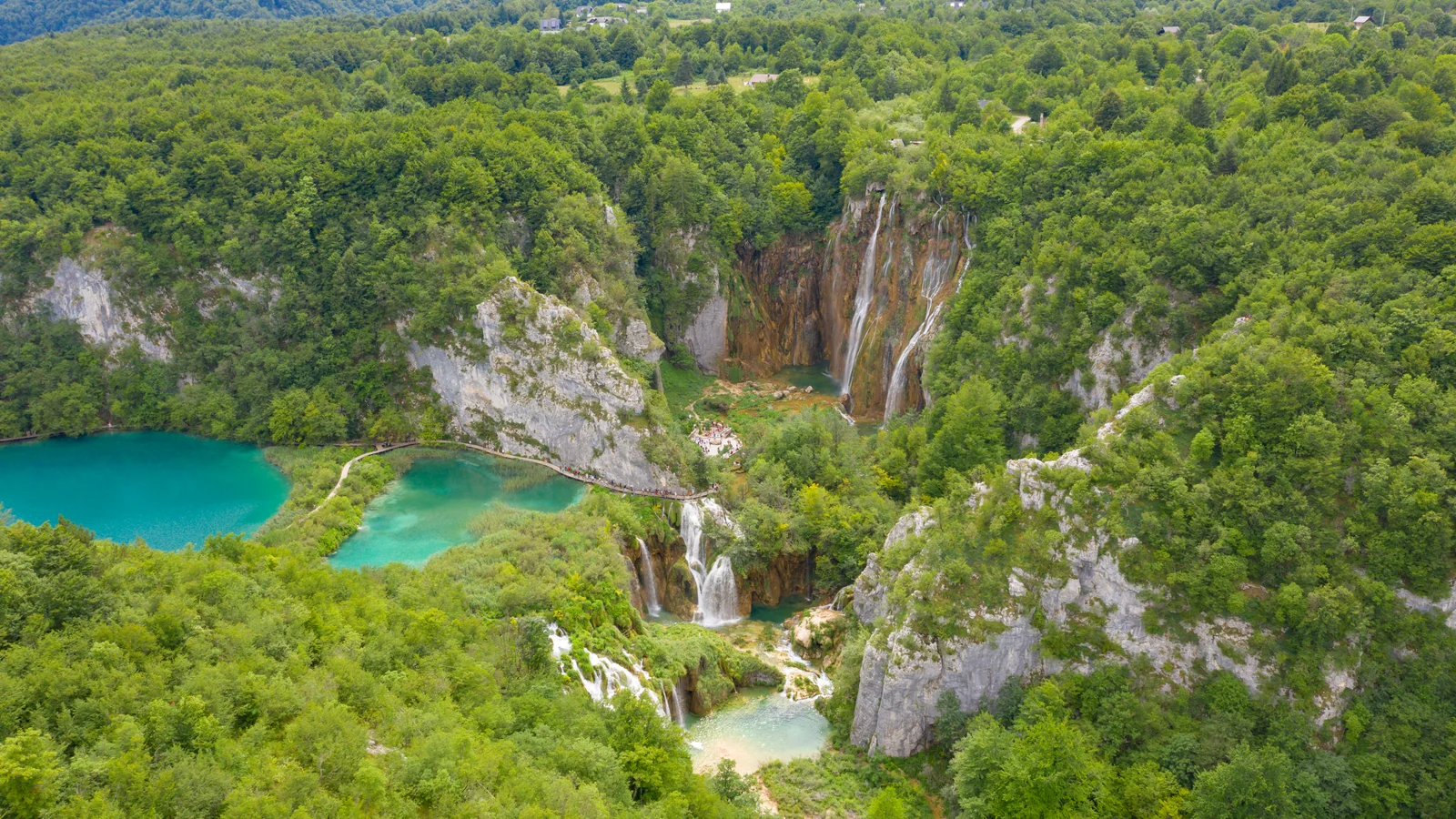 Caption: Morning sunlight cuts through mist across the turquoise basins of the Lower Lakes gorge.
The Upper Lakes: Subdued Waters and Dense Beech Forests
The Upper Lakes sit higher in the valley, cradled by thick old-growth forests of beech, fir, and spruce. Twelve lakes make up this upper tier, starting at Lake Prošćansko at 636 meters above sea level and cascading down through Lake Ciginovac, Lake Okrugljak, and Lake Galovac.
Here, the water moves through wide, braided networks. Trails wind over timber walkways that skim inches above crystal-clear pools where brown trout hover against the current. The soundscape of the Upper Lakes is softer than the lower canyon. Water trickles through dense reeds, mossy hummocks, and wide woodland steps, creating a tranquil setting that feels far removed from the dramatic vertical drops downstream.
The Lower Lakes: Sheer Cliffs and Roaring Plunges
Downstream of Lake Kozjak, the topography shears into a dramatic limestone canyon. The Lower Lakes, comprising Milanovac, Gavanovac, Kaluđerovac, and Novakovića Brod, drop through vertical rock walls reaching forty meters in height. The mineral concentration here shifts the water color from deep emerald to electric cyan.
At the terminus of the Lower Lakes system stands Veliki Slap, the Great Waterfall. Fed by the Plitvica River rather than the lake chain itself, Veliki Slap drops seventy-eight meters in a single sheer plunge against a red-streaked limestone wall. It is the tallest waterfall in Croatia, and on hot summer afternoons, the spray creates a continuous rainbow over the viewing platform.
| Waypoint / Landmark | Elevation | Distance | Difficulty | Key Highlights |
|---|---|---|---|---|
| Entrance 1 (North Gate) | 545 m | 0.0 km | Easy | Lower canyon overlook, view of Veliki Slap |
| Veliki Slap (Great Fall) | 505 m | 1.2 km | Easy | 78-meter sheer plunge, limestone amphitheater |
| Lake Kozjak Crossing (P3) | 535 m | 3.8 km | Moderate | Electric boat dock, lakeside picnic meadows |
| Galovački Buk Cascades | 580 m | 6.5 km | Moderate | Braided travertine drops, dense moss networks |
| Lake Prošćansko Shore | 636 m | 11.2 km | Strenuous | Quietest upper waters, wild brown bear habitat |
| Stubica Viewpoint | 702 m | 14.5 km | Strenuous | High-angle canyon vista away from timber paths |
Choosing the Right Circuit: Navigating Trail Networks
The park authorities signpost several designated routes labeled A through K. Routes A, B, and C focus on shorter loops starting from Entrance 1, while Routes E, F, and H depart from Entrance 2. During peak hours, these standard loops become congested, moving visitors in single-file lines across the narrow timber boardwalks.
To experience the park on your own terms, you must look toward the perimeter trails, particularly the comprehensive Route K, which circles the entire watershed.
Field Note from the Trail: Purchase park tickets online at least two days in advance; entrance is strictly capped by hourly quotas. Arrive at Entrance 1 precisely at 07:00 when the turnstiles open, or wait until after 16:30 when tour buses depart. Wear shoes with sticky vibram rubber soles. The oak boardwalks are constantly wet from waterfall spray and become dangerously slick under ordinary running shoes.
Trail K: The Ultimate Wilderness Circuit
If you possess sturdy boots and eight hours of stamina, Trail K offers the definitive Plitvice waterfalls hike. Spanning roughly 18 kilometers, this loop skirts the outermost rim of the lake system, leaving the crowded boardwalks behind to climb into the quiet beech forests that harbor wolves, lynx, and European brown bears.
Starting at Entrance 1, Trail K leads past Veliki Slap before climbing the canyon wall via stone switchbacks. Rather than descending immediately to the ferry crossing at Lake Kozjak, the path leads north along the lake’s western bluffs. You hike under dense woodland canopies where the forest floor smells of damp earth and wild cyclamen.
The trail winds all the way to the southern tip of Lake Prošćansko, where you will encounter few fellow hikers. The return leg runs along the eastern ridges, delivering panoramic views across the entire karst valley. The perspective from these elevated ledges makes the Lower Lakes look like polished turquoise stones set into gray rock.
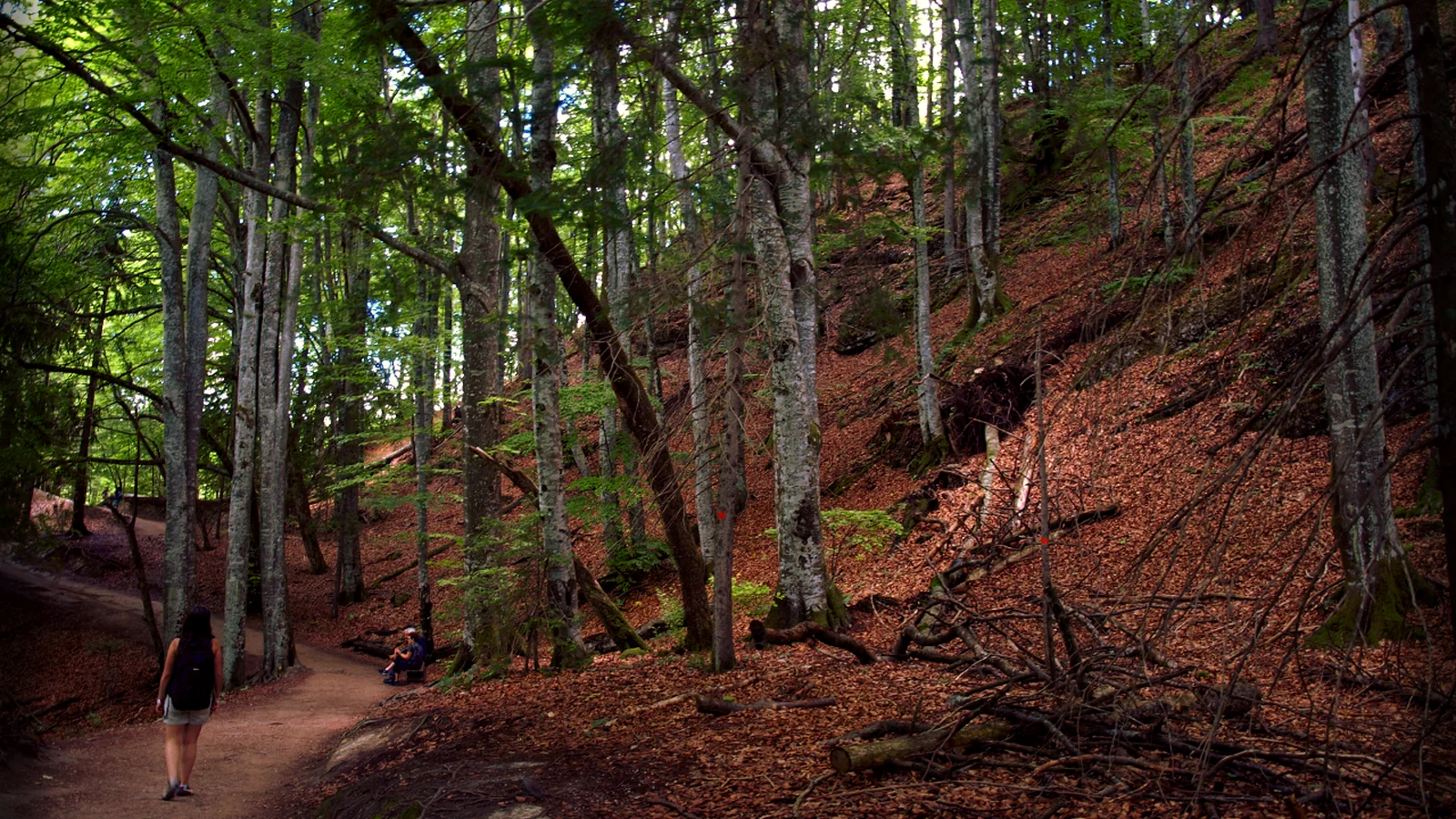 Caption: Rustic oak-timber boardwalks hover inches above the travertine cascades of the upper lakes.
The Stubica Overlook: Escaping the Wooden Walkways
Between the Upper Lakes and the western bluffs lies Stubica peak, reaching 702 meters above sea level. A spur path off Trail K climbs steeply through beech trees, gaining roughly 150 meters of elevation over two kilometers.
Few travelers take this detour, opting instead to remain beside the water. Those who climb Stubica are rewarded with unobstructed views across Ciginovac and Okrugljak lakes. From this vantage point, the structural architecture of the travertine dams is laid bare. You can clearly trace how each lake feeds the next through green spillways, an angle impossible to appreciate from the boardwalks below. The serenity here mirrors the secluded high trails found in our Hallstatt Alpine Village guide.
Logistics: Getting to the Lika Highlands
Plitvice Lakes National Park sits inland within Lika-Senj County, approximately halfway between Zagreb and the Adriatic coastline. Accessing the park requires a bit of planning, especially if you plan to arrive before the crowds.
Entrance Information & Operating Hours
- High Season (June to September): 07:00 to 20:00
- Shoulder Season (April to May, October): 08:00 to 18:00
- Winter (November to March): 08:00 to 16:00
- High Season Single-Day Ticket: €40 per adult
- Shoulder Season Ticket: €23 per adult
- Winter Ticket: €10 per adult
Public Transit and Driving Routes
Direct buses operated by Arriva and Prijevoz Knežević depart from Zagreb’s central bus station (Autobusni Kolodvor) daily, taking roughly two hours and fifteen minutes to reach the park. Buses also run regularly from the coastal transport hub of Zadar, taking around one hour and forty-five minutes. A one-way ticket typically costs between €12 and €18.
If driving, take Highway A1 and exit at Karlovac if arriving from the north, or Gornja Ploča if coming from Split. Route D1 is well-maintained and winds through the rural, rolling terrain of the Lika plateau. Parking costs approximately €1.50 per hour in the designated forest parking areas at both Entrance 1 and Entrance 2.
Alpine Lika Cuisine: Fuel for the Trail
Hiking twenty kilometers along karst ridges demands hearty nourishment. The Lika region is renowned across Croatia for simple, robust food designed to sustain shepherds through bitter winters.
After finishing your hike, skip the cafeteria-style dining halls near the parking areas and drive five kilometers north to the village of Grabovac or south toward Korenica. Look for traditional family-run konobas featuring open hearths.
Regional Dishes to Order
- Janjetina s ražnja: Whole lamb roasted slowly over beechwood coals, seasoned only with coarse Mediterranean salt and served with fresh spring onions and thick bread.
- Lički krumpir: Protected regional potatoes baked in their skins, dense and buttery, often paired with cold cuts of cured ham.
- Sir Škripavac: A young, fresh cheese made from raw cow or sheep milk. Its name comes from the squeaking sound it makes against your teeth as you chew.
- Boranija or Grah s kupusom: A slow-simmered bean stew cooked with pickled cabbage and cured pork ribs, ideal for warming up during chilly autumn visits.
- Wild Berry Strudel: Thin pastry rolled around tart mountain blackberries, blueberries, and sweetened cottage cheese.
Pair your meal with a shot of šljivovica, a potent homemade plum brandy, or velebitsko pivo, a dark, malty beer brewed nearby on the slopes of the Velebit mountain range. For hikers who enjoy culinary culture connected to rugged landscapes, this rustic fare rivals the coastal spreads featured in our Amalfi Coast Trails overview.
Seasonal Strategies: Timing Your Arrival
The character of Plitvice Lakes changes dramatically across the calendar. Choosing when to visit will dictate whether you encounter thundering torrents or crystalline autumn mirrors.
Spring (May to June)
The spring thaw swells the rivers, sending walls of frothing water over every tufa ledge. May brings vibrant light green foliage to the beech canopies, and wildflowers blanket the woodland trails. However, high water levels can occasionally submerge lower boardwalks, forcing brief trail closures.
Autumn (September to October)
Autumn is arguably the finest season for hiking. The park’s beech and maple trees turn gold, amber, and crimson, reflecting off the dark teal lakes. Temperatures cool to a comfortable 14 to 18 degrees Celsius, making long loops like Trail K far more pleasant than in the stifling heat of July.
Winter (December to February)
When sub-zero winds sweep down from the Velebit range, Plitvice freezes into a cathedral of blue ice. Veliki Slap hardens into colossal icicles, and the timber paths disappear beneath thick snowdrifts. While portions of the Upper Lakes close for safety, the Lower Lakes remain open to visitors equipped with warm waterproof boots and traction spikes.
Frequently Asked Questions
Can you swim in any of the Plitvice Lakes?
No. Swimming, wading, and watercraft use by visitors are strictly prohibited throughout the entire national park. The ban protects the delicate tufa-forming ecosystem and preserves water purity. Violators face steep fines from park rangers.
How much time should I spend at the park?
While a rushed visit to the Lower Lakes can be completed in three hours, a proper exploration requires a full day of six to eight hours. Staying two nights in a nearby guesthouse allows you to hike the Upper Lakes during one morning and the Lower Lakes the following morning, both times avoiding peak crowds.
Is Plitvice accessible for travelers with limited mobility?
Only partially. The park terrain is rugged. While the overlook path near Entrance 1 provides wheelchair-accessible views of Veliki Slap from above, most paths consist of uneven timber boardwalks without railings, rustic dirt switchbacks, and stone staircases that are unsuitable for strollers or wheelchairs.
Should I start at Entrance 1 or Entrance 2?
Entrance 1 is ideal for first-time visitors seeking immediate views of the Lower Lakes canyon and the Great Waterfall. Entrance 2 is better for hikers aiming to complete the Upper Lakes early or those looking to join Trail K away from the main tour bus hubs.